Tuesday, October 16, 2007

Taxing Times

The Chancellor's decision to change the Chapital Gains Tax (CGT) rate to a flat 18% and abolish taper relief seems like a gut reaction to the fact that private equity bosses are only paying 10% on their 'carry' on successful investments. Caught in the cross fire are entrepreneurs that now are going to have to pay nearly twice as much tax on exit. The fact that the Enterprise Investment Scheme (EIS) allows up to £400K of any gain to be rolled over into a new venture softens the blow, but these changes that come in in April 2008 give a big incentive to exit before then!

Thursday, October 11, 2007

Sainsbury Boost For Connect

Lord Sainsbury’s review of the UK science and innovation system. includes a glowing endorsement of the CONNECT model:

Recommendation 9.5
Drawing on the success of the CONNECT scheme in San Diego, RDAs [Regional Development Agencies] should support services for high-technology entrepreneurs around our world-class universities similar to the CONNECT service within the BSSP [Business Support Simplification Program] framework.

Connect assists technology-based companies and entrepreneurs in refining their business and financial strategies through a group mentoring process. It assists with the development of business plans and business presentations, and provides a forum in which the entrepreneurs can present their refined business model before a group of business, marketing and management experts. The scheme’s success steams from its holistic approach, the range of expertise it provides and the fact that “none of us are as smart as all of us”.

Wednesday, October 10, 2007

Distance No Object?

VCs often tell me that it’s the quality of the company that drives the deal, not the geography. So is where you start a business really that important? According to Library House London is a magnet for new venture capital backed businesses despite the expensive rent and salaries. They point to the number of successful exits as a ratio to the number of deals done as an outcome measure. Apparently, in London the ratio is 2:3 whereas in the North the ratio is no more than one in four. Does this in any way relate to the geographic remoteness from the major financial market? One blip in this statistical argument appears to be the Emerald Isle where, albeit from a lower base, the ratio of exits to deals is one in two. Maybe it’s the Guinness that aids the deal making!

Is one way of breaking down these geographic barriers to utilise technology more? Connect has recently released a online portal, http://www.mydealmaker.co.uk/, designed to allow companies wherever they are to pitch their investment proposition whenever they want. The idea is that even if a VC can't find the time or the rail fare to come to our Investment Forum, they can at least take a looksee at the cream of the technology crop from across the region. Equally, entrepreneurs no longer have to wait for the next Forum to come around in the hope that they get a presentation slot. We look forward to our first online investment success and to improving our ratios!

Monday, October 08, 2007

Online Research Versus Legwork

There seems to be an increasing trend to research opportunities online before expending too much physical effort evaluating the options. Who last went looking around a new neighbourhood looking for houses, rather than first having a trawl of Rightmove? Tesco have just launch a new comparision website to compete with the likes of MoneySupermarket. So there must be money in them there hills. And with MyDealMaker debuting, even venture capitalists and angel investors can get in on the act and search for entreprenurs with big ideas looking for funding that meet their search criteria.

Where will it all end? In the lead, not supprisingly, is Formula One. Car design is apparently moving from using computer simulation to validate an hypothesis to ab initio models where nothing physical is made until the computer says yes. Drug design has similarly embraced the idea that sampling chemical space is best done virtually before that expensive step of synthesising anything is taken and anyone gets their hands dirty.

Who, thirty years ago, would have believed that computers would be used for screening potential dates/mates before 'pressing the flesh'! And if you had said we would all be texting like mad, rather than videoconferencing by now you would have been laughed out of the room. As the BT futureologist at a recent YSTN event commented, maybe we should be employing more phycologists to help design new products, rather than leaving this entirely to the technologists!

Tuesday, September 25, 2007

Fail Fast, Fail Early

Not the most inspiring of titles, but ask any medicinal chemist what the chances of his or her lead molecule making it through clinical trials and it's about one in ten (and falling). And no matter what anyone tells you, no one knows which development projects will fail when on the journey from the lab to your bathroom cabinet. Yes, that pill you pop for hay fever or hypertension is the result of a whole lot of great science and one big dose of good fortune.

The development strategy of big pharma embraces this fact as they seek to spend the least amount of money on the ones that don't make it. Fail fast, fail early is their mantra. So why don't they run tests in parallel (assuming it's ethical and legal) and speed up the process? Unfortunately, with these odds history and a few calculations in Excel tells you its a mug's game to try to rush perfection to much. What you need is a development pipeline (which is what equity analysts sweat about as the last blockbuster goes off patent) and then you can play the numbers game and be reasonably patient.

But wait, what about small guy who just has one or two throws of the dice and mix in a doze of commercial reality that their wonder drug or medical device has a limited market potential? And what if they don't have the luxury of funding their development from previous successes? Then they have to raise funding from VCs who don't want to wait a decade to see a return and even then the market potential may not give sufficient returns to make the investment add up financially. This is the problem facing many Healthcare Technology companies and it ain't easy to beat the numbers.

Complaining about the short time horizon and greediness of VCs is about as useful as trying to rush a product through clinical trials (and by that I mean spend more money on failures faster). It just isn't that productive. So what is the answer to this connundrum? The obvious answer is to licence more things earlier and accept a smaller slice of the pie if they make it through to market - which is what most smaller biotechs do. Alternatively, you can find a friendly source of development funds that is prepared to wait for a return and see your project through from cradle to grave - it's called working for Glaxo! But is there a third way?

Monday, September 24, 2007

InvestorQuest Final

The Saturday Yorkshire Post featured our Red Carpet Day where the 10 InvestorQuest finalists fought it out for a slice of the £1M of funding on offer. Whether they are successful in their quest only time will tell, but four walked away with £1K of consultancy support kindly donated by the event's sponsors Clarion solicitors (who hosted the event), Murgitroyd & Co, Mazars and Turnkey.

It was interesting reviewing the initial comments of the panel of investors. There concerns were less about how clever the technology was, but more about whether the IP was protectable, barriers to entry, routes to market, vertical market focus vs infrastructure play, return on investment, etc. Although each presenter was mentored prior to the event, only a minority had developed these aspects sufficiently to satisfy the investors appetite for business strategy, rather than technical detail.

Thursday, September 13, 2007

Developing an Innovation Strategy

Rob Hulme from Smith & Nephew spoke at the first of our Business Fitness workshops in Hull on developing an innovation strategy. He emphasised their strategy has moved from closed innovation to a more open approach to embrace ideas from outside. Another of his themes was the concept of teamwork and cross-functional approaches noting that breakthroughs often occur at the interface between two disciplines.

A interesting observation was on the competing pressures of Process & Bureaucracy and Passion & Anarchy that a company needs to find an appropriate balance between to maximise its potential. Too much bureaucracy and innovation risks being stiffled in favour of the status quo. But equally too many mavericks trying to change and tinker with things then chaos reins.

This complemented my discussion in the previous session on Business Strategy & Planning where I focused on the chasm between Visionaries and Pragmatists. Visionaries are by definition more driven by passion and a quest for radical improvement, whereas Pragmatists are looking for more incremental, managed evolution to improve the current situation. Most managers coming from larger companies have these pragmatic skills in spades, but may lack the open mindedness and willingness to experiment and even fail that sets out the visionaries from the rest.

There are four more seminars in the series which promise to be equally inspiring! Click here to find out more...

Monday, September 03, 2007

What Is The Optimal Length Of A Queue?

There is a fine line in business between having satisfied customers and happy ones. If all your customers are too happy you are probably not charging enough for your product and service or indeed doing too much for them for too little. This can be a difficult habit to break, but can be the difference between success and failure.

Early in my career I worked for a software company that everyone loved, they just didn't make any money and were taken over by another company that did. The only difference I could make out between the two was the one that was successful charged their customers for everything they could and should. The other went out of its way to keep its customers happy, but didn't charge them enough for the privilege.

Do you want to be liked or respected in business? If it's the former, you probably think the answer to the question posed is zero. If it's the latter, a better answer is three...

Monday, August 13, 2007

That Original Idea

As we embark on our InvestorQuest Challenge, we ask are you like John Nash in A Beautiful Mind (looking for that original idea that will be the basis of your business, rather than just delusional). Surprisingly, good ideas for a business are often less than original and are often pretty simple. In 1978 (yes, nearly thirty years ago) I wrote a program to play blackjack, so you could blame my 'idea' for all those Internet betting sites out there today. Simon Nixon, the founder of moneysupermarket.com, had a brilliantly simple idea to provide consumers with independent comparison of insurance products that he took from inception through to a £1B stock market flotation.

What differentiates those that succeed is often not the idea for the business, but their single minded focus to exploit an idea and find an addressable market for it. Turning a fledgling idea into a marketable product is the key and so is avoiding the pitfalls along the way. That's why when asked whether an investor is more interested in the idea or the management, often the answer is the latter. Good ideas are surprisingly plentiful, it's the ability to execute that maketh the business. That said, you need an idea!

Tuesday, August 07, 2007

Don't Trash The Competition

Marketing is all about differentiating yourself from the competition, but what's with the current spate of adverts that lead on what's wrong with your competitors, rather than what's right with you? I was always told never to speak badly of the competition when in the company of customers. "I couldn't possibly comment" says eons more than any direct insult ever could.

This seems to be a bank thing. Nat West and Nationwide are both running TV adverts parodying a fictitious bank that doesn't listen to its customers and employs morons. Maybe it's just me, but I can't help thinking the only association created is precisely the unintended one.

Has anyone done any studies on this? Put viewers in a room and show them the employees in the advert and ask who they work for. My guess is that there will be a significant correlation that isn't the desired one. Surely, a marketing agency is spending millions of pounds on this without thinking this one through (surely, it doesn't work like that?). Or just maybe mud does stick to the slinger...

Saturday, August 04, 2007

Work On The Business, Not In It...

The Prime Minister, Gordon Brown, has curtailed his holiday in sunny Dorset to rush back to Downing Street following the outbreak of foot and mouth disease on a British farm. Is this driven by a need to be seen to be doing something from a PR perspective or does the CEO of UK Plc need to work on his delegation skills more?

Any good CEO has to balance involvement (interference?) in operational matters against taking a more strategic view. Delegate to little and too much weight lands directly on his/her shoulders. Delegate to much and risk the fate of Metropolitan Police Commissioner Sir Ian Blair by being accused of not being in control.

A key stage in any business is when the CEO can focus on working on the business, rather than in it. This requires that a management team is assembled that can take primary responsibility for operational matters. Sure the CEO might be the best person to do everything and make every decision (which he probably had to do to in the early days), but he or she has to sleep sometime (and even take the odd holiday).

Thursday, August 02, 2007

Suck IT and See

Do visionary/successful companies try lots of things consistent with their goals and and keep the stuff that works. Or do they know exactly how to get to where they want to be and home in on perfection like a wasp buzzing towards your pint of beer?

The ultimate suck it and see company has to be 3M. All things big start off small, but who knows for sure what will grow? They recognised that you need to develop a pipeline of little things and keep nurturing those that work. Time to market is also key. In the 1970's Glaxo was one of many drug companies climbing the greasy pole. Then their researchers discovered a potential wonder drug, ranitidine. Instead of doing toxicology testing sequentially, they decided to save time by running the toxicity studies in different species in parallel. By taking a calculated risk Glaxo were first to market and the rest, as they say, is history.

So one could conclude that if you want to make a bee line for success, you need to take a leaf out of Charles Darwin's book and try lots of things and keep the ones that work, and if you are going succeed, make it snappy!

Friday, July 06, 2007

Connect Yorkshire on FlickR


We have set up a Connet Yorkshire Group on FlickR and posted some of the photos from our recent Investment Forum there.

If you would like to join this group and view the photos, click on the following link


Monday, July 02, 2007

Death Of Animal Testing

An interesting article in June 18th issue of C&E News predicting reduced animal testing in favour of experiments utilising human cells and components by the USA National Research Council. They say advances in systems biology and methods to test cells in vitro is reaching the stage where it will provide more information on human toxicity than high-dose in vivo testing on animals.

This may cheer our Venturefest Yorkshire Business Plan winner, Kirkstall Ltd. who are developing a multi-chamber bioreactor that utilises human cells. To read the NRC report, click here.

Friday, June 29, 2007

Those Who Can Do

I have been involved in developing software applications for more years than I care to remember and here are a few thoughts:

  1. You are only a naive user once. Watch a new person try to use your software application and learn from what they can't easily do. Once you are trained, anything is intuitive.
  2. You don't build new software the way you build a house - those that try to make it into a linear process with prescriptive completed outputs at every stage are doomed to failure - even if the project plan looks pretty. There is always a non-deterministic aspect to any complex system. Agile approaches, adaptive planning and iterative development is needed.
  3. That said, you should always seek to reuse building blocks and design the components of the system with this in mind. If you have to reinvent the wheel each time, you are doing something wrong.
  4. Don't expose too many end users to pre-alpha software (apart from those sacrificial virgins mentioned in 1) - they will not be able to see past the first bug/crash/wobbly and will not thank you for an early look at anything short of perfection.
  5. So don't let core developers design a user interface. Their perspective is clouded by what is going on deep in the bowels of the system. A business analyst that has empathy with and understanding of the user requirements should always be part of the team and in small projects is more important than a 'project manager'. They can fein selective amnesia to immitate 1 and 4.
  6. Everyone is qualified to criticize and say what’s wrong with a system; it’s a lot harder to contribute innovative ideas and define what’s right!

Thursday, June 21, 2007

TechTalk 2007

TechTalk 2007, held in conjunction with the Connect Yorkshire Investment Forum, saw speakers focus on what is the recipe for high-tech success. Gwyn Humphreys emphasised that customers can often be your cheapest source of money and if you can cut a deal with early adopters where they help fund development of the technology, then that is a great way to avoid giving away too much equity too early on. At the other end of the spectrum, Stephen Allott emphasised that if you have a developed product, the secret to world domination is a motivated and well incentivised sales force. Steve Garnet from Salesforce.com evangelised about software as a service and the rise of utility software. This goes hand-in hand with a 'pay as you go' subscription model, rather than upfront licencing. My experience is that this is a win-win if software companies can adapt to this model from a cash-flow perspective as it is a lot easier sell product and the revenue stream is annuitised, which is highly valued by an investor. Graham Bowland from Surgical Innovations spoke about the challenges and rewards of entering the US market. Overall a great afternoon of inspirational talks!

Tuesday, June 12, 2007

10 Things Not To Get Wrong When Building A Technology Business...

At the i-techpartners academy event at Daresbury, Richard Veal from New Mind reflected on what he had learnt (the hard way!) in building his business, a lot of which resonated with my own experiences:

  1. There isn't a shortage of work to go around - collaborate, build on the work of others and stop your techies insisting on reinventing the wheel.
  2. Ideas are cheap and surprisingly plentiful, it's implementation that's hard. It also helps to focus on one idea, so select the right one!
  3. Don't believe your own hype: success is not necessarily replicable and equally if you fail at first, try and try again.
  4. Being an MD is a lonely place - you need advice, mentoring and an external perspective.
  5. Generic business advice is useful, but specific advice is invaluable from someone who really understands your market/technology.
  6. Get your organisational structure right as soon as you can. An average employee in the right structure (and motivation) is better than a good employee with the wrong one.
  7. Build in scalability into your business model from day one; it's hard to retrofit.
  8. You will need twice as much time and money as you thought you would!
  9. Networks are important to long term development. External focus is needed to understand the wider picture and assess impact internally.
  10. Success is specific, run your own business - it's your story, write it.

See also my top ten tips on raising investment!

Friday, June 01, 2007

£25 Million Entrepreneur Challenge


The Bank of Scotland Corporate have launched a £25 Million Entrepreneur Challenge with the aim of providing support for driven, well-established businesses that aim to continue growing and become dominant forces in their markets.

A maximum of five businesses will share up to £25 million of funding plus valuable business opportunities. With a funding package of up to £5 million entirely free of interest for three years, each of the successful businesses will also gain coverage for their business in the pages of The Sunday Times and exposure to local media, along with opportunities to network with some of the UK's top entrepreneurs.

Sounds like a serious way to gain both finance and profile.... The closing date for entries is 15 August 2007, Good Luck!

Wednesday, May 30, 2007

Fuelmyblog


If you are looking for a new blog to read or want to find out what others are reading online visit Fuelmyblog.com.

The website allows bloggers to publicise their own blogs for free and recommend other sites by voting on them. It also has useful forums were you can go to get top advice on how to market your blog and increase your readership - it's worth a visit!

Fuelmyblog is the the brainchild of a group of Yorkshire entrepreneurs who have teamed up with a British blogger in France to launch the new business venture. Kevin Dixie based in La Rochelle, Ian Green of Green Communications and Marcus Dyson of Eleventeenth.com have big plans for the site and will be introducing podcasts, compeitions, blog chat radio and a range of other features.

Friday, May 18, 2007

Girl Power

Library House reported some depressing statistics this week in their newsletter. Comparing the numbers of male to female business leaders, Library House demonstrated that women are not just lagging behind in the career stakes - they seem to have fallen off the scale all together.

The article left me wondering where all the girl power had gone.... The low lights of the article included that 95 per cent of the chief executives at venture-backed companies were men and even worse, in 2006, 97 per cent of newly appointed chief executives were men.

Despite being woefully out numbered the stats did point out that when a women was in the driving seat the company performed better. Female chief executives delivered higher revenues using less capital and the average company run by a woman had annual revenues of €12.5m last year compared to €11m for those run by men! Hooray - a ray of light.

So where has all the girl power gone? Since working for Connect Yorkshire I have often wondered why the technology business sector is so dominated by men. Very rarely do we come across a female entrepreneur and even less likely is a female investor. You only have to turn up to one of our Investment Forums to see just have out numbered the girls are.

Maybe it's because in the past there have been few role models. Women who have taken on the business world and really succeeded without being viewed as cold hearted (or of having an unhealthy obsession with shoulder pads) were few and far between.

I certainly do think that the generation of female 20 and 30 some things now coming have the positive role models needed and more critically have the confidence to know that they are just as likely to achieve as their male counterparts. Coupled with flexible working conditions that make it easier to achieve work/life balance I hope that when Library House repeats the stats in 5 - 10 years time it will show a completely different story.

Thursday, May 17, 2007

BarCampSheffield

There is a BarCamp happening in Sheffield on the 26th / 27th May 2007 at PlusNet, Internet House, Sheffield, S1 4BY

For those who don't know what BarCamp is the following definition is on Wikipedia: BarCamp is an international network of unconferences — open, participatory workshop-events, whose content is provided by participants — focusing on early-stage web applications, and related open source technologies and social protocols.

BarCamps are organized (and evangelized) largely through the web, harnessing what might be called a Web 2.0 communications toolkit. By "open-sourcing" the organizational process of a Foo Camp unconference, that is, codifying it in a wiki and making that publicly available, BarCamp seems to have struck a chord. It has since been implemented in 31 cities around the world and is serving as a reference for unconferences in other fields.

The organisers of BarCampSheffield rightly point out that the UK is at the forefront of innovation within the areas of Web 2.0, OpenID, Social Networking etc.. They feel that the north of England is full of enterprising and innovative individuals / businesses who want a event outside of London where they can talk to kindred spirits. Everyone is welcome - click here for more information.

Friday, May 11, 2007

Hot science, cold commerce


We spotted an interesting article - this weeks Science Business Viewpoint . In it Domenico Valerio talks about the lessons he learned whilst starting-up a gene therapy company. Domenico is now a general partner in a new Dutch venture capital fund, Aescap Venture and also gives insight into the kind of entrepreneurs he’s now looking to fund.

The top tips we picked up on are:

Know the strengths and weaknesses of your technology
Don't be a scientific entrepreneur with your heart lost on the technology, be more of an entrepreneur than a scientist

Work with the best
That includes investors, as well pulling together a top management team and passionate staff

Say no to the second best
Even when there is pressure for the business to grow, don't take on second rate employees

Create a culture in the company that is business-like
Understand your customer from an early stage. Licensing activity may be a difficult strategy to adopt but the benefits are not just about generating cash. It can give you an insight into your customer's perspective that you may not other wise get until it is too late.

Thursday, May 10, 2007

Accessing the right finance


We take calls every day from entrepreneurs wanting to know what funds they can access for their growing businesses. Sometimes they might be able to get their hands on a grant but mainly its bank finance, loans or equity investment that are their better options.

Our workshop next week with deal with this subject and help will be on hand to explain exactly which options you should be going after.

Accessing Support and Funding and Due Diligence by Investors starts at 4pm on the 16th May and will be held in Leeds.

Wednesday, May 09, 2007

Log your blog

We have just added MyBlogLog to our blog - its a way of finding out more about the people who are reading your blog.


For all this talk of a global conversation throughout the blogosphere, there's a lot to be desired. It's a two-tiered system, with bloggers talking amongst each other and the majority of the readers looking on from the fringes. You may get to call out something from the sidelines by leaving a comment, but things could be so much better. For everyone.

MyBlogLog enables you to take advantage of your existing presence on the Web and ties it into communities of like-minded readers and authors to add context to the conversations in which you take part.

So if you have a blog on your company website make sure you add MyBlogLog - that way your readers will be able to see each other and you will have better visability of your potential customer base.


Thursday, May 03, 2007

Is the World Flat or Spikey?

Jonathan Kestenbaum, Chief Executive of NESTA, spoke at the Leeds University Innovation & Enterprise Gala Dinner about what factors enable innovation to flourish. He focused on one main theme: The world of innovation is 'spikey' and regions need to develop the support infrastructure and conditions to make them more likely to be where ideas 'happen'.

Moving from a linear process to a richer/broader model, bringing together cross functional teams with innovation occurring at the interfaces of disciplines. Ecology/systems of innovation and the view that innovation occurs in pockets, rather than it being able to thrive anywhere i.e. the world of innovation is not flat! Going against Thomas Friedman's thesis The World is Flat: a Brief History of the 21st Century, he argued Atlantic Monthly's view that the "The World is Spikey" is more to the point.

The trick is to leverage tacit knowledge, that shared uncodified stuff and deploy key strengths, rather than simply try to replicate what was done elsewhere: you can't simply clone silicon valley. The emphasis on networking, serendipidy and common purpose resonated with the Connect model.

Wednesday, May 02, 2007

DIY Social Networks

Whilst surfing the internet we came across Ning.com a website that allows you to create, customize, and share your own Social Network for free in seconds.


Started in 2004 Ning powers over 46,000 social networks and counting. We discovered some useful networks for the budding entreprneurs inlcuding My Start UP Network and SmallBizPod .

For all those who are keen to give their business the web 2.0 makeover they have private label options for businesses. Perphaps this could be the perfect way to communicate with your customers and for them to chat to each other???

Thursday, April 26, 2007

mentoring + money = success

A winning formulae for early-stage technology companies includes mentoring says NESTA mentor, Alan Edwards.

In his recent article on the NESTA website, Alan very wisely talks about how entrepreneurs (and those who investment in them) should make sure they have mentors who are able to provide advice on the basic elements of running a business but who also have sector specific knowledge.

He goes on to explain that given seed funding, early stage businesses have a limited time before that money runs out. To get another round of funding, they have to prove that they have achieved their year-one objectives and are capable of managing any resources awarded to them. All of this on top of coping with the fundamental issues of starting a business. Mentors can help with making judgement calls - helping to ensure that the business remains focused and on track.


But where do you find a mentor? Hopefully the below links will be a starting point in your search...

NESTA have a network of over 200 mentors to provide expert business advice
The Unit is a business incubator centre in Leeds that provides it client businesses with a pool of mentors
Forward Ladies is a business Womens' network and support group with a mentoring scheme
Mentor Bank run by South Yorkshire Investment Fund and has over 450 mentors


Tuesday, April 24, 2007

Top ten tips on how to attract investment

Needless to say you’ve come up with a great idea and all you need is some money to make it happen. Here are my ten top tips on how to attract an investor:

1) Come up with a persuasive elevator pitch that captures the essence of what your idea is and what problem it solves.

2) Demonstrate passion and commitment: an investor wants to know you are going to put all your energies into making your idea a success.

3) Research your market. Make sure you have validated that there is a demand for your product or service and can quantify the market opportunity.

4) Know your competition. You are out to steal their lunch, so make sure you can articulate the benefits of your solution over theirs - and remember no competitors equals no market!

5) Start selling as soon as you can. The quicker you prove your value proposition and can start generating revenues the better – real customers are you best friend when it comes to raising finance.

6) Write a business plan. Your financials projections should be based on realistic assumptions and don’t forget to say what you will use the money you are looking to raise for.

7) Acknowledge your limitations and explain how you intend to overcome them. You may not be the finished item and be honest about the challenges you face.

8) Practice makes perfect, so in developing your investment pitch rehearse, rehearse, rehearse.

9) Be persistent: You will have to kiss a number of frogs before you find your prince and typically the process of finding an investor can take six months.

10) Be choosy who you accept investment from. Do they bring anything other than money to the party? And remember you are going to have to work with them, so you need to be able to get along.

Hook a Business Angel


Do you know how to write a business plan and hone your executive summary in order to get the attention of an investor?

Find out how potential funders will view your business plan, what they look for, and how to ensure they get beyond the first page at the Connect Yorkshire’s next workshop.


Practical Business Plans and How to Hook an Angel

Wednesday 2nd May 2007
The Headingley Suite, Crowne Plaza Hotel, Wellington Street, Leeds, LS1 4DLN
4:00pm for 4:30pm start, finishing at approximately 6:45pm


This is the first workshop in Connect Yorkshire’s forthcoming Investor Readiness Programme in Leeds. Enrol on all or any of the free events and benefit from our unrivalled expertise in helping technology and knowledge-based companies, like yours, raise finance - whether bank, grant, loan, venture capital or business angel.

The programme is a series of six free-of-charge workshops, all to be held in the evening in Leeds with a buffet.

If you have a great business idea but face a funding gap these workshops will help you protect your idea, refine your business plan, hone your sales pitch and, generally, make the most of your proposition. Maximise your chances of raising finance and do all you can to ensure your business achieves its potential, register now for all or any of the workshops.


We look forward to seeing you there!


Wednesday, April 18, 2007

Listen in

We like the SmallBizPod, a podcast for small businesses, start-ups and entrepreneurs in the UK.


The latest podcast examines the European technology/web sector and the state of venture capital on the continent with Alex Vieux, publisher of technology business magazine Red Herring.

It's definitely worth a listen...

Friday, April 13, 2007

I'm blogging whilst on Myspace, YouTube, Facebook, Bebo, Linked In....


Victor Keegan of The Guardian wrote an interesting piece on blogging in yesterdays edition.
In it he discusses a survey by Technorati indicates that the expand of blogs and bloggers continues, with an estimated 70 million weblogs! However the uptake has been at a slower rate than antipicated and that blogs haven't taken off in the way that social networking site such as Myspace have.

With over 170 million members of Myspace and 5,000-plus videos uploaded to YouTube every day blogging is lagging behind. Victor sees this as a preference to communicate directly with others who have similar interests and opinions rather than just sticking a weblog out there in the internet universe for any man and his dog to read. We couldn't agree more.....

Connect Yorkshire has recognised that online networking is a powerful force and will soon been provide busy entrepreneurs with MyDealMaker. The portal will be an online networking space that will provide technologists and investors with a way to make contact and forge deals. It will have with all of the web2.0 facilities you could wish for! Watch this space.


Thursday, April 05, 2007

Join the Club

Reducing your carbon footprint has become a priority for many people in the UK and it seems investors are as keen to pump cash into all things green.


We noted that Whizzgo, the pay-as-you-go car hire business has been in the news again this week - this time with the launch of the scheme in Sheffield.

Whizzgo's concept is to provide cars to hire by the hour, at short notice, within a few minutes walking distance of a drivers home and workplace. By offering a car club service that is convenient giving up your car is now becoming a real alterative.

Managing director Charlotte Morton pitched for funding at the
Connect Yorkshire Investment Forum in November 2005 and since then, Whizzgo has netted quarter of a million pounds worth of funding from Yorkshire venture capital group Viking Fund.

It seems other investors have recongised the potential of the car club phenomenon and we noticed that
Streetcar the UK-based self-service car rental company, raised £6.4m (€9.5m) from Smedvig Capital this week.

Thursday, March 29, 2007

The closing gap

Good news! The funding gap is closing – well if you believe everything you read that is.
The equity gap, a financial market gap identified as €250.000 to €2.5 million across Europe, is being addressed and by the ever increasing activity of Business Angels. The number of business angel networks has more than doubled in the last ten years. Coupled with the training of entrepreneurs to receive such funding, such as our Investor Readiness Programme, research in both the US and Europe shows that business angels are the most important source of funding for the seed and start-up phases of enterprises.

However, The European Business Angels Network (EBAN) has issued a White Paper entitled “Stimulating the European informal venture capital market: The contribution of business angels to the EU strategy for growth and jobs” which calls for yet more action to plug the gap. The business angel market in Europe is estimated at €1,5 billion, ten times less than that in the US so we still have some catching up to do!

Here in Yorkshire, The Viking Fund has made a huge difference to technology companies looking for finance and is a good example of how business angels fill the gap.

Science Business has some interesting comments on the white paper and you can see the full report here

Friday, March 23, 2007

VCT Downdraft

The Budget 2007 has put a size limit of 50 employees and a total investment of £2M for Venture Capital Trust investments, which maybe will drive dealflow into our area of activity. I don't have any stats, but I would guess previously very few VCTs would have invested in this sector and most AIM flotations will be above the VCT investment limit going forwards - a number of established AIM VCTs have already pulled their 2007/8 offerings.

How about someone creating a VCT targeted specifically at smaller technology companies with significant growth potential?

Tuesday, March 20, 2007

Foolish angels rush in where the best angels fear to tread

We spotted a NESTA article discussing why VCs should invest in angel-backed deals. It makes for an interesting read and hails the smart business angel as the best way for a business to prepare for later stage investment.

Its true that the 'best of breed' angels bring far more to a business than just cash.

Surely VC's already know who the smart business angels are and are already montioring their every investment....

Friday, March 02, 2007

PwC Technology Round Table

Some interesting discussion, but mainly heated agreement on what the issues are surrounding early stage technology investment. Too few business plans are sufficiently un-sieve like, too much focus on the business plan and numbers rather than the idea and market opportunity. Too few corporate finance teams having the necessary technical appreciation to hone business plans. Lack of funding in the £500K to £1.5M range. Conservatism and fear of failure rather than embracing risk and accepting this as a necessary element of reward in the capital markets. When an investment is overwhelmingly obvious, its too late!

An interesting thought about trying to spot the next big thing might be to consider the psychology element and try to understand the needs and aspirations of people, rather than focusing on what the technology can do. Text messaging being a case in point - if anything this was a backward step in technology but everyone 'does' it and BT could have introduced it long before mobile phones appeared. Video phones have yet to hit that same sweet spot despite being infinitely neater technology...

Wednesday, January 31, 2007

The Business of Innovation

Attended this event at the National Media Museum, Bradford, organised by Yorkshire Forward and the Centres for Industrial Collaboration. The Yorkshire Science debate was interesting and reminded us once again about the lack of Proof-of-Concept funding in the region to help fledgling technology innovators. The difference between innovation and enterprise (entrepreneurship) was interesting and emphasised the need for teamwork - to get both skills in one person was rare. And the perennial issue of failure (or fear of it) was raised from the floor and from the panel. The theme that if we are not failing often enough we are not taking enough risks was an interesting if provocative one.

Tuesday, January 23, 2007

Pareto's Law, Miller & Moore

Otherwise known as the 80/20 rule, Pareto's Law states that 80% of outputs comes from 20% of the inputs. For example, you are developing an investment portfolio of early stage companies. Given an appropriate filtering process you back five companies. Pareto's Law states only one in five will probably really fly. But which one? The managers among you want to eliminate the 80% and concentrate on the 20%, but which 80%? Pick the wrong 20% and you will be out of the money. So is it better to simply try to screen investments better and buy into Pareto's Law?

Bill Miller, an investment manager state side, has beaten the S&P 500 for the past 13 years. He has a stock screening system that flags up investment opportunities. He's bought into Pareto's Law and four out of five of his investments end up bombing, but the one in five that succeed pay him back in spades. He is a successful investor, but readily admits he has no idea which of the investments that get through his screen will be 'the one'.

Law's Moore is associated with the microchip speeds, but more generically says that in a competitive situation, the imperative to improve is constant. So maybe we should be seeking to improve our screening process (which is what Connect Yorkshire tries to do). Pareto's Law is omnipresent and we have to embrace it, but we can all raise our game as much as we can to load the dice in favour of being in the successful 20%

Tuesday, January 02, 2007

Global Connect

Budgetary constraints may have precluded any direct participation, but the Global Connect conference blog and podcast can be downloaded here.

Tuesday, December 05, 2006

Connect Scotland

The SEP Technology Leaders Forum held in conjunction with the Connect Scotland Investment Forum features a number of influential speakers. One theme of discussion was that in the UK, unlike the USA, there is a big role to be played to connect entrepreneurs to sources of finance. The view was that in the USA VCs are "pacing the corridors of universities with checkbooks in hand".

The perception of the panel was that the difference is cultural: In the USA many VCs have technology backgrounds, while in the UK they primarily are financial beasts. Bridging the gap in understanding of the science is more important in Europe. To some extent this need is being met by the likes of IP Group and Biofusion, but the danger is that projects that don't meet their investment criteria may be constrained rather than facilitated.

Any tech-savvy VCs or university commercialisation outfits out there that have a view on this?

Monday, November 27, 2006

Those That Could Go Either Way

I'm no economist, but it seems to me that the strength of the regional economy is particularly dependent on loading the dice in favour of success for technology companies that maybe could 'go either way' or operate in a niche. Some contribute high-quality jobs to the economy, such as media companies and those dependent on individual creativity, but will never scale beyond a certain size. Many and often is the key to success for these boutiques, not trying to distort their business model.

Simon Hill, director of enterprise at Yorkshire Forward, emphasised at Vikingar (see previous post) that government intervention is best targeted at companies that have the potential for high growth. The key point here is that we want growth of high-quality jobs and more successful companies. Government support and invention is best targeted, not at the beacons of success (although I can understand the wish to dwell in their shadow), but more the small bonfires that are in danger of just smoldering, unless some help and support in their early stages of development. Getting more reluctant entrepreneurs to try starting a business, or giving high-quality advice and support to fledgling enterprises that could go either way is where the difference needs to be made.

Friday, November 17, 2006

Vikingar

Some highlights from the Vikingar event organised by the Viking Fund. Charles Arthur, technology editor of the Guardian, emphasised the importance of Blogs and RSS push technology in alerting him to stories of interest. Ian Weatherhog from Standford Technology raved about Web 2.0 and how inclusion and community is what its all about. Jotted down “swarm” and “flock” as sites to check out.

Interesting debate about the importance of good management versus good technology. One view I heard expressed by a university spin-out was that if the technology is innovative and a market opportunity exists, everything else, including the management, can be fixed (and probably has to be in that context!). However, the overwhelming view of the audience was that good management was of paramount importance. The key point is that navigating from anything like a good idea to an addressable market through the innovation minefield requires a blend of management skill and experience.

And that relates to my view that too much money can be a bad thing, as it takes the pressure off the management to validate their value proposition in the market. Far too many young technology companies fail to embrace potential early adopters and sell something however badly! As ever the alternative also occurs as many of the propositions we see are being just too precious with their equity and should be raising far more money to make the most of their opportunity. A small slice of a bigger pie is invariably better than 100% of nothing! Also a valid point made by Andrew Burton was that invariably these companies need a second round of financing and multiple fund raising rounds diverts management attention from growing the business.

As I let the audience retire to the bar in good time in return for some Blog comments, I look forward to seeing this site race up the Google rankings. Who knows we may even end up on Charles Arthur’s news feed!

Thursday, November 02, 2006

Points Win Prizes

Funding comes in all shapes and sizes. Maybe one for the adventurous, but the Genomics X Prize has just been announced that promises $10M for the first successful sequencing of 100 human genomes in 10 days. This kind of high-throughput (low cost) genetic profiling is a prerequisit to usher in the era of personalised medicines.

More bite-size prize challenges can be found on the Innocentive web site that seeks to match up scientific problems of commercial worth with 'solvers'. Only problem is that if you solve one of the challenges you have to sign over the IP rights...like any fund raising you have to give some to get some!

Wednesday, October 18, 2006

18 Mistakes Startup Make

Thankls to Edward French at Enterprise Ventures for pointing me to this link http://paulgraham.com/startupmistakes.html. Necessary reading.

Tuesday, October 03, 2006

The World's Largest Seed Capital Fund

A Private Members Bill sponsored by Kitty Ussher gets its second reading this autumn which calls on the Government to implement a framework similar to the USA's Small Business Innovation Research Programme, which ensures that 2.5pc of the Federal R&D budget (worth $1.8billion in 2006) goes to young technology firms.

David Connell from Cambridge University's Centre for Business Research has written a report called "Secrets of the World's Largest Seed Capital Fund" and is leading the campaign for bringing such an initiative to the UK. Clearly, it could play a major role in helping to fund early stage technology businesses and give them a slice of the R&D pie that has traditionally gone exclusively to the Universities and larger research organisations. Improved access to proof-of-concept funding and seedcorn capital is needed to help nurture early stage science and technology companies and Connect Yorkshire applauds this initiative.

On a related theme, Red Planet Capital is a non-profit organisation that is establishing a strategic $75M venture capital fund for NASA. The purpose of the fund is to provide NASA earlier and broader exposure to emerging technologies. It is designed to promote the future availability of technologies with both government and commercial applications that can meet NASA's future mission requirements. The effort signifies the administration's commitment to creative approaches for promoting innovation in pursuit of America's space agenda.

Hot on its heals, is the MOD seeking to inspire innovators from across Britain to bid for a slice of £10M to develop their ideas further to help meet key defence challenges. See www.ideas.mod.uk.

Monday, September 18, 2006

"I hate to lose, but I am not afraid to fail."

A comment attributable to Thierry Henry in an advertising hoarding on the A64 out of Leeds that caught my eye that is a good a definition of the entrepreneurial streak as I have seen. 'Being an entrepreneur is about winning and money is a way of keeping score' is another quotation that comes to mind.

The bottom line is that, as in sport, there are no guarantees of success but equally there is no substitute for preparation. That's why coming up with a well thought out business plan is key. This week we will be holding the InvestorQuest finals and it will be interested to see how many of the business propositions can articulate exactly what they do and why they might be one of the winners...unfortunately, as in sport, by the time its obvious who the winners are, it's too late to back them!

That's why investors seek to load the dice in their favour by looking for attributes that they have seen in ventures that have generally made it in the past: clear vision and value proposition, strong management that can navigate the troubled waters to success, understanding of the competitive landscape, a feasible route to market, etc. While standing out from the crowd is good, being too different by not coveing one of these bases is not to be recommended. The Investor Readiness Programmes we run seek to ensure companies looking for investment show themselves in the best possible light.

Tuesday, September 05, 2006

Raising Finance

Came across the following article that had some good points about growing a business and the balance to be sought in raising finance - particularly the need to keep an eye on two balls!

http://uk.biz.yahoo.com/05092006/244/score-funding-vcs.html

Friday, August 18, 2006

SBS report “ A mapping study of VC provision to SMEs in England”. The research was done Dec 04 - March 05. Its 94 pages long; in the following extracts I use the para numbers from the report. YH means Yorkshire and the Humber.

3.14 YH’s ratio of public to private funds is relatively low compared to the North West and Merseyside, the West Midlands and the South West.

8.14 YH has the lowest “estimated value of investment 2003-4”

8.15 YH has the lowest investment activity at the seed level (8%) whereas eg NE has 28% of all investments at the seed level

8.17 YH has the lowest percentage of investment in the IT and Healthcare, as opposed to services, manufacturing and other

Chart 56 commenting on the low level of seed investment in YH “ This reflects the fact that there are few seed focused funds in the region.”

Tuesday, July 25, 2006

InvestorQuest £1M Challenge

Fancy getting your hands on your share of the Ă‚£1M earmarked by our sponsors, VIKING, YFM, EV and WYPOCF, for investment in early-stage companies seeking funds? Then check out the InvestorQuest page of our web site for more information. The whole Connect team has been at Kirkstall Abbey shooting some promotional pictures dressed as knights seeking the holy grail -which turned up in a trophy shop in York! Looking the part, we got into the Yorkshire Post on Saturday! Join the quest for the 'holy grail' a share of £1m business ...

Monday, July 17, 2006

Getting A Reaction Going


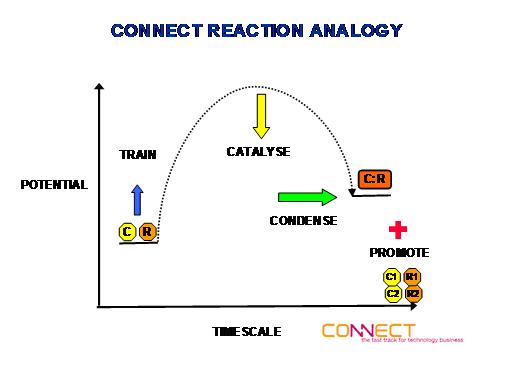
The activities of Connect Yorkshire can be catagorised into four areas and the chemists among you can think of us as being involved in a reaction. We train companies to help then make the most of what they have got and put their best foot forward, maximising their standalone potential. We help catalyse growth by lower the activation barrier to change and condense the journey, so they get to where they want to go faster. And we promote innovation, by bringing together more and more companies with the resources they need to succeed and raising the temperature and pressure to increase the chances of associations forming. This analogy to a chemical reaction is pertinent as we develop our activities.

Wednesday, July 12, 2006

Award nomination for Connect sponsor

We nominated one of our sponsors, Shaun Mullins of Horwath Clark Whitehill as IOD Yorkshire & Humber Business Advisor of the Year and its great that he has been shortlisted; the award will be at a Gala Dinner on 7 September

Friday, July 07, 2006

Lack of Proof of Concept Funding

We need more people starting up knowledge-based businesses. We have to acknowledge success if far from certain. There will be failures: unless there are we, as a region, are being too conservative in our thinking. However, with the help of organisations like Connect we can load the dices in favour of success and avoid the mistakes of the past. Enterprise and innovation is not a one way street. We need good technology that matches to a market need. All too often an idea misses the mark; aligning the technology with an addressable market need is what innovation is all about. Connecting entrepreneurs with the resources they need to nurture their initial seed of an idea until it reaches sustainability is a key part of the equation.

A key part of this that is lacking in the Yorkshire region is Proof of Concept funding. If we look to our neighbours, the North East has a £10M fund, set up to stimulate the growth of new technology companies. The North West similarly has access to the Rising Stars fund that backs early stage companies. These funds typically put £25-60K into a company at inception, with the option to invest further if the idea is shown to have legs. What access do would-be entrepreneurs have to funding at this level in the Yorkshire region? The reality is very little, but this is a key part of the innovation landscape.

Some pump priming is needed if we expect the region to generate sustainable technology businesses further down stream. The reality is that 3 out of 4 of these investments may not generate a return, but the ones that do will make up for the others - or that is how it should be if we are finding the correct balance between risk and reward.

Sunday, July 02, 2006

Promoting an Enterprise Culture

Creating a more enterprising culture is fundamental to the future of the regional economy. We need to applaud innovators and risk takers, celebrate their successes and help them avoid many of the potential pitfalls that stand in their way. That's where we come in: Connect Yorkshire helps young technology companies by linking them with the resources they need to succeed: investment, markets, management, partners, and support services. We are here to help businesses that need a boost to reach their 'escape velocity'.

Connect has been active in Yorkshire for nearly four years and has help over a hundred technology companies raise over £13M of investment. Every year numerous more technology companies attend Connect’s various programmes. The vast majority of these businesses are started by normal people who have seen a gap in the market or how to do something quicker, smarter or cheaper.

Starting a new technology business is not easy and its a long hard road, but the potential rewards are great - just ask James Dyson! Connect brings together like-minded people and together we all achieve more than we could ever alone. If you are thinking of starting a technology business or have a great idea but don't know how to progress it, come and talk to us. We are here to help.

Friday, June 30, 2006

Academic Involvement Benefits Everyone

While we have a lot of general business savvy people involved in our Company Assessment Groups (CAGs), but we are looking to involving more academics who might provide insights from a technical perspective. We also hope this will help promote a more enterprising culture by exposing participants to the commercialisation process. Maybe they will be inspired to start their own business or realise something they are working on in the lab has commercial legs. What's interesting is that the solution orientation of many fledgling companies coming from the private sector, contrasts the universities, where the technology comes first and the application second. Maybe we need to come at this issue from both ends to maximise our outputs.

Yorkshire has universities with world class research and teaching credentials. Almost 80 per cent of the departments at the University of York, for example, were given 5 or 5* ratings for research, meaning research was of international importance. Three of our universities are within the top 30 in the UK. Why then is the Yorkshire and Humber region languishing in 8th place for innovation in the UK? The way to ensure a better research to innovation ratio is to increase the amount of research inspired by commercial needs and bridge the gap between technology and commercial exploitation.

Any academics intrigued by all this, please contact Glen Hopkinson at Connect.

Monday, June 26, 2006

A Public-Private Partnership That Works

Connect is a perfect example of public-private partnership that works. As a not-for-profit company, Connect plays a pivotal role at the interface between technology, enterprise and business. We are part supported by a grant from Yorkshire Forward, but that’s only part of the story. Over thirty companies partner with Connect to deliver its programmes. The involvement of our sponsors is invaluable and contributes immensely to the quality and relevance of the product. In addition, Connect can tap into the skills of many of the region’s most successful technology entrepreneurs. This invaluable knowledge and experience is on offer to young technology companies across the region.

Friday, June 23, 2006

Yorkshire Forward Bioscience Awards

Prof. Heinz Woolf spoke after dinner and made a number of good points. According to Prof. Woolf, people who generate ideas may not be the best ones to sort the good from the bad (from a commercialisation perspective). What they need is input from a good 'editor' - someone who understands science and business, and has the scars to prove it! This involvement may be quite limited, but key to choosing the good ideas and driving them in a commercial direction. Once a proof of concept is achieved, someone then has to run with the idea and dot the i's and cross the t's. Again this may need someone else who is more operationally orientated: a details person. Rarely is one person good at doing all three (or interested in them). Indeed, it may be a mistake to try to make academics into entrepreneurs by asking them to cross over from being a generator of ideas to a running a business. Food for thought! The dinner was good also.

Friday, June 16, 2006

Investment Forum On A High

Record numbers of companies presenting, investors with cheque books at the ready, and a champagne reception to finish. What more could you want? The event got great media coverage, with a number of the presenting companies raising their profile by being featured in the local press. All the presenters benefited from our mentoring process and this resulted in some well honed pitches that impressed the panel. The general concensus seemed to be that this was the best event we have ever held. Check out the Connect Yorkshire website for Podcasts of each of the presentations.

Tuesday, May 23, 2006

Company Assessment Group Meetings

In the run up to our June Investment Forum we are holding a number of 'CAGs' to help the presenting companys hone down and refine their investment pitches. This is an invaluable opportunity for presenter's to get feedback, share good practice and eliminate glitches. Often it is not until entrepreneurs have made their pitch to investors and been turned down that they appreciate what they could improve on - and then it's just too little, too late. The CAGs are made up of the mentors that are assigned to each company that are drawn from our sponsors. The companies get high-quality feedback from people in the know. So when they present at the Forum, they have the best possible chance of winning over investors and raising the finance they need to make their dreams a reality. This mentoring and support is a key part of the Connect model.

Tuesday, May 16, 2006

Bioscience YorkshireEnterprise Fellows

Academic research targeted explicitly at producing commercialisable technology is the focus of what is said to be the largest cluster of its type in Europe. And its happening here in Yorkshire!
The Bioscience Yorkshire Enterprise Fellowship is designed for post-docs, researchers and PhD students who have the skills and the desire to create a business based on their research. The programme provides participants with the support and mentoring to commercialise their ideas and research findings. The goal of the scheme is to increase entrepreneurial activity in Yorkshire universities' bioscience departments and to accelerate and support the formation of solid and sustainable start-up bioscience businesses.

Attending presentations from the fellows, you could see how fired up about their research they were - but also how producing a commercial outcome was also explicitly part of their mindset - something that might have been alien to them had not this scheme focused their deliverables towards an addressable market! In the end this is what differentiates technology development from enterprise. Nearly half of the fellows are thinking about starting a business based on their ideas. Great stuff!

Thursday, April 20, 2006

Focusing on Selling

Most technology companies spend there 'youth' developing some IP and sometimes that's all they ever do. Their novel idea results in something that can be licenced to other companies that focus on exploiting this in the market. However, for many technology companies it is up to them to go out and sell their product or service. This requires a whole new skill set and focus that may not come naturally to the founders of the business. How you get past this growth stage is critical. The ability to demonstrate repeatable sales, significantly increases the chances of raising finance to fund expansion. All too many of the investment propositions we see have left it too late to start selling!

Indeed, many such innovators may believe all they need to do is make it! The reality is that only innovators in your market will seek it out. To really make the numbers stack up someone has got to go out and sell the dam thing to people that really could go either way! So you don't just need a good product, you need a good sales and marketing strategy -- and the people to execute. Get selling as soon as you can! If the objection is that your product needs another bell or whistle don't accept this. Someone, somewhere has to buy into your vision. This validation is key to raising investment. Go and get some ASAP!

Friday, April 07, 2006

The Enterprising Enterprise Show

For anyone thinking of starting up a business The Enterprise Shows are well worth a visit! I attended the Leeds event last Saturday and was extremely impressed with the amount of information immediately accessible to budding entrepreneurs.

Talk about time saving, in one place you can get instant advice on your business plan, talk to banks about financial issues, listen to real life experiences of business success, learn about funding, finding investment, insurance, patents, trading standards…………………. the list goes on. It certainly helps cut through the mass of support now available to new businesses and you can soon work out what’s relevant to you.

The HM Revenue and Customs team had a queue of people waiting to speak to them most of the day, who would have thought VAT was so interesting!

Thursday, March 30, 2006

Mapping Start-ups

I was reading Electronics Weekly last week, as you do, and noticed their ‘start-up map’. Listing all the young electronic businesses across the UK, it was really interesting to look at their geographical spread.

I’m afraid the Yorkshire region doesn’t exactly look like a hot bed of emerging technology within this sub-sector of technology. In total 5 companies were based within the boundaries of Yorkshire. Although I didn’t find this particularly surprising what did astound me were the numbers of companies coming out of the South East. 24 businesses were listed under Cambridge alone. No wonder we have difficultly persuading VCs to travel ‘up north’ - they have exciting investment prospects on their doorstep, and plenty of them.

That said, I know that the majority of companies that access Connect Yorkshire’s services have an IT base. Yorkshire definitely has greater activity within other sub-sectors of the technology industry, particularly within the digital and creative areas. Looking at the number of start-ups in the electronics sector in isolation is therefore not a true reflection of Yorkshire’s high tech talent. Our last Investment Forum in November proved that high quality deals in a sizable number are there for the taking.

For me what the map highlights is the power of transcending traditional regional boundaries particularly when attracting big spenders from the south. The North East had 4 businesses listed whilst the Manchester area had 6. If this start-up activity were pooled with Yorkshire’s 5 businesses then the pulling power of the north would be greater. Perhaps then it would be easier to convince a VC the train journey was worth the time and expense!

Tuesday, March 07, 2006

YORKSHIRE’S TECHNOLOGY SECTOR 2020

Technology has been a buzz word in Yorkshire’s economic strategy for a number of years now. Technology is seen as an industry that has the potential to revitalise sub-regional economies, following the withdrawal of traditional industries. However despite all of this hype Yorkshire and Humber is still ranked eighth in a table of the most innovative regions in the UK.

So, how will the next 14 years shape up for the technology sector? I would argue that it depends largely on a change in culture among both our students at schools and universities and in business.

Creating the entrepreneurial attitude takes a lot of change. When you get right down to it, the attitudes of the young come from their role models, parents and teachers. We need to encourage our schools to celebrate British business success, and create a different attitude towards entrepreneurship.

A great example of a different attitude is America’s approach to business failure; I understand that in the US venture capitalists don’t like investing in you unless you’ve had at least one business failure. Here they turn up their nose at anyone whose company has gone onto insolvency. The Americans like those who have had the hard experience of trouble and the bottle to try again.

At Connect Yorkshire we prime technology companies for investment and growth. Every year about 40-50 technology companies attend our various programmes. The vast majority of these have been started by people who have been working in an industry for 10 or more years. They see a gap in the market, or a new development not being exploited by their employer, and try to build a technology business to fill that gap. Contrary to popular belief, the majority of new technology businesses do not come out of universities.

Universities by their very nature concentrate on academic research, and not on business creation. Research funding largely comes from the public sector, and is awarded purely on the quality of research – as judged by other academics, not on how much a university has contributed to the regional or national economy.

The way to ensure a better research to innovation ratio is to increase the amount of research inspired by commercial needs. This is where funding from research–led businesses is invaluable.
At the heart of the issue is that while research and innovation – defined as the commercial exploitation of ideas - maybe symbiotic, they are not synonymous; research does not necessarily yield innovation.

Over the last 20-30 years we have had three major technology businesses in Yorkshire, Systime in the 80’s, and Pace and Filtronic have continuing success from the 90’s to today. Systime employees have gone on to found numerous IT businesses in their own right. A few more success stories on this scale will give the technology sector in 2020 a significant boost.

Local medical device companies harbour a huge wealth of talented scientists; individuals experienced in product development, regulatory and advanced manufacturing. Johnson and Johnson Wound Management in Gargrave, Smith and Nephew in York and Hull and Depuy in Leeds are huge international companies with a strong footing in the region. Could it be by 2020, Yorkshire is considered the hub of Britain’s medical device industry?

It’s a strong possibility and emerging companies such as Cell Tran, Ullsys, and Avanticare prove with the correct support anything is possible. Success breeds success and if Yorkshire is perceived as a centre of medical device excellence the battle of attracting and then retaining key individuals to the region will be a lot easier. This will be helped by the activities of IP2IPO at Leeds and York Universities and Bio Fusion at Sheffield University.

These White Rose universities have the ability to support a flourishing medical device industry as we head towards 2020. In addition, I believe there will be many more technology businesses coming out of the students from Sheffield Hallam, Leeds Met, Hull, Bradford and the other non White Rose universities.

Brains must earn a crust too

We produce some of the best research academics in the world, yet their knowledge is locked away within the hallowed halls of academia.

The UK economy would benefit hugely from the innovation and technology which universities produce, but despite noises from central government about business and academia working together, the vast majority of academic revenue remains untapped.

Yorkshire has 12 higher education establishments - some with world class research and teaching credentials. Almost 80 per cent of the departments at the University of York, for example, were given 5 or 5* ratings fro research, meaning research was of international importance. Three of our universities are within the top 30 in the UK.

Why then is the Yorkshire and Humber region languishing in 8th place for innovation in the UK? Only the North East, Northern Ireland and Wales fare worse.

The answer is that the mindset behind attributing and recognising academic excellence is wrong. Currently the Research Assessment Review is carried out every four to five years. The process involves a panel of 685 people reviewing almost a quarter of a million pieces of research from 56,000 academics.

On the back of this huge bureaucratic exercise approximately £1 billion of research funding is allocated to UK universities. Incredibly nowhere is a university’s contribution to business or the economy mentioned.

In 2002 the government’s Investing in Innovation report stated that: “In an increasingly knowledge-driven global economy invention and innovation are critical to Britain’s long-term competitiveness. This requires a virtuous circle of innovation: from the very best research in science, engineering and technology in universities and science labs to the successful exploitation of new ideas, new science and new technologies by businesses.”

Currently the allocation of research grants appears to miss half of this “virtuous circle”. Yes, it assesses the quality of research, but it takes no account of “successful exploitation”.

In common with other sectors, higher education is subjected to league tables which institutions desperately try to climb. Research ratings play an important part along with other factors such as teaching quality assessment and entry standards.

However if we look at how university’s are ranked by employers the results are strikingly different from the usual research/teaching quality league tables published in five of the national broadsheets – the Daily Telegraph, Financial Times, The Times, and the Sunday Times.

For example the University of York is ranked from second (in the Daily Telegraph) to eighth (in the Financial Times). However when surveyed by 200 firms which regularly recruit graduates York’s ranking slips to twenty-ninth.By contrast, Leeds University is ranked between twenty–second (in the Telegraph) and thirty-fifth (in the Times); when it comes employers Leeds is ranked ninth in the UK.

Of course within Yorkshire there have been significant, if not fundamental, steps towards improving the situation. Three of our university’s have organisations which carry out a commercialisation function. Leeds University works with Techtran and IP2IPO. Sheffield University has two organisations - SUEL (Sheffield University Enterprises Ltd) and Bio Fusion, which is tasked with commercialising the IP output from the Biology and Chemistry departments. York, which is relatively new to the technology transfer game, has employed business development officers to help with its commercialisation activity.

SUEL has spun out 40 companies and created 60 external jobs. Techtran has also had its share of success with high profile spinouts including Syntopix and Potopharmacia under its belt. In York the Science City partnership between the university and the city council has created 60 companies and 2,600 jobs in the wider science and technology sector.

Other organisations such as Connect Yorkshire are also playing their part in helping young technology companies grow and become successful businesses contributing to the regional and national economies.

There have been some spectacular successes. BioFusion, spun out of Sheffield University, floated on AIM and raised £8.2 million. Bradford Particle Design, started by Dr Gwyn Humphreys of Bradford University in 1995 was acquired by Inhale Therapeutic Systems for £137m. Molecular Skincare, founded by Dr Simon Ward of Sheffield University, was brought by York Pharma for around £5.5 million.

These are fantastic achievements, but they are achieved despite the pervading culture of academic institutions and not because of it. To fulfil our national and regional potential we need fundamental changes in how we evaluate our universities. We must not be squeamish - the rest of the UK runs on capitalist money making principals and we cannot afford for our top brains not to.