Wednesday, January 31, 2007

The Business of Innovation

Attended this event at the National Media Museum, Bradford, organised by Yorkshire Forward and the Centres for Industrial Collaboration. The Yorkshire Science debate was interesting and reminded us once again about the lack of Proof-of-Concept funding in the region to help fledgling technology innovators. The difference between innovation and enterprise (entrepreneurship) was interesting and emphasised the need for teamwork - to get both skills in one person was rare. And the perennial issue of failure (or fear of it) was raised from the floor and from the panel. The theme that if we are not failing often enough we are not taking enough risks was an interesting if provocative one.

Tuesday, January 23, 2007

Pareto's Law, Miller & Moore

Otherwise known as the 80/20 rule, Pareto's Law states that 80% of outputs comes from 20% of the inputs. For example, you are developing an investment portfolio of early stage companies. Given an appropriate filtering process you back five companies. Pareto's Law states only one in five will probably really fly. But which one? The managers among you want to eliminate the 80% and concentrate on the 20%, but which 80%? Pick the wrong 20% and you will be out of the money. So is it better to simply try to screen investments better and buy into Pareto's Law?

Bill Miller, an investment manager state side, has beaten the S&P 500 for the past 13 years. He has a stock screening system that flags up investment opportunities. He's bought into Pareto's Law and four out of five of his investments end up bombing, but the one in five that succeed pay him back in spades. He is a successful investor, but readily admits he has no idea which of the investments that get through his screen will be 'the one'.

Law's Moore is associated with the microchip speeds, but more generically says that in a competitive situation, the imperative to improve is constant. So maybe we should be seeking to improve our screening process (which is what Connect Yorkshire tries to do). Pareto's Law is omnipresent and we have to embrace it, but we can all raise our game as much as we can to load the dice in favour of being in the successful 20%

Tuesday, January 02, 2007

Global Connect

Budgetary constraints may have precluded any direct participation, but the Global Connect conference blog and podcast can be downloaded here.

Tuesday, December 05, 2006

Connect Scotland

The SEP Technology Leaders Forum held in conjunction with the Connect Scotland Investment Forum features a number of influential speakers. One theme of discussion was that in the UK, unlike the USA, there is a big role to be played to connect entrepreneurs to sources of finance. The view was that in the USA VCs are "pacing the corridors of universities with checkbooks in hand".

The perception of the panel was that the difference is cultural: In the USA many VCs have technology backgrounds, while in the UK they primarily are financial beasts. Bridging the gap in understanding of the science is more important in Europe. To some extent this need is being met by the likes of IP Group and Biofusion, but the danger is that projects that don't meet their investment criteria may be constrained rather than facilitated.

Any tech-savvy VCs or university commercialisation outfits out there that have a view on this?

Monday, November 27, 2006

Those That Could Go Either Way

I'm no economist, but it seems to me that the strength of the regional economy is particularly dependent on loading the dice in favour of success for technology companies that maybe could 'go either way' or operate in a niche. Some contribute high-quality jobs to the economy, such as media companies and those dependent on individual creativity, but will never scale beyond a certain size. Many and often is the key to success for these boutiques, not trying to distort their business model.

Simon Hill, director of enterprise at Yorkshire Forward, emphasised at Vikingar (see previous post) that government intervention is best targeted at companies that have the potential for high growth. The key point here is that we want growth of high-quality jobs and more successful companies. Government support and invention is best targeted, not at the beacons of success (although I can understand the wish to dwell in their shadow), but more the small bonfires that are in danger of just smoldering, unless some help and support in their early stages of development. Getting more reluctant entrepreneurs to try starting a business, or giving high-quality advice and support to fledgling enterprises that could go either way is where the difference needs to be made.

Friday, November 17, 2006

Vikingar

Some highlights from the Vikingar event organised by the Viking Fund. Charles Arthur, technology editor of the Guardian, emphasised the importance of Blogs and RSS push technology in alerting him to stories of interest. Ian Weatherhog from Standford Technology raved about Web 2.0 and how inclusion and community is what its all about. Jotted down “swarm” and “flock” as sites to check out.

Interesting debate about the importance of good management versus good technology. One view I heard expressed by a university spin-out was that if the technology is innovative and a market opportunity exists, everything else, including the management, can be fixed (and probably has to be in that context!). However, the overwhelming view of the audience was that good management was of paramount importance. The key point is that navigating from anything like a good idea to an addressable market through the innovation minefield requires a blend of management skill and experience.

And that relates to my view that too much money can be a bad thing, as it takes the pressure off the management to validate their value proposition in the market. Far too many young technology companies fail to embrace potential early adopters and sell something however badly! As ever the alternative also occurs as many of the propositions we see are being just too precious with their equity and should be raising far more money to make the most of their opportunity. A small slice of a bigger pie is invariably better than 100% of nothing! Also a valid point made by Andrew Burton was that invariably these companies need a second round of financing and multiple fund raising rounds diverts management attention from growing the business.

As I let the audience retire to the bar in good time in return for some Blog comments, I look forward to seeing this site race up the Google rankings. Who knows we may even end up on Charles Arthur’s news feed!

Thursday, November 02, 2006

Points Win Prizes

Funding comes in all shapes and sizes. Maybe one for the adventurous, but the Genomics X Prize has just been announced that promises $10M for the first successful sequencing of 100 human genomes in 10 days. This kind of high-throughput (low cost) genetic profiling is a prerequisit to usher in the era of personalised medicines.

More bite-size prize challenges can be found on the Innocentive web site that seeks to match up scientific problems of commercial worth with 'solvers'. Only problem is that if you solve one of the challenges you have to sign over the IP rights...like any fund raising you have to give some to get some!

Wednesday, October 18, 2006

18 Mistakes Startup Make

Thankls to Edward French at Enterprise Ventures for pointing me to this link http://paulgraham.com/startupmistakes.html. Necessary reading.

Tuesday, October 03, 2006

The World's Largest Seed Capital Fund

A Private Members Bill sponsored by Kitty Ussher gets its second reading this autumn which calls on the Government to implement a framework similar to the USA's Small Business Innovation Research Programme, which ensures that 2.5pc of the Federal R&D budget (worth $1.8billion in 2006) goes to young technology firms.

David Connell from Cambridge University's Centre for Business Research has written a report called "Secrets of the World's Largest Seed Capital Fund" and is leading the campaign for bringing such an initiative to the UK. Clearly, it could play a major role in helping to fund early stage technology businesses and give them a slice of the R&D pie that has traditionally gone exclusively to the Universities and larger research organisations. Improved access to proof-of-concept funding and seedcorn capital is needed to help nurture early stage science and technology companies and Connect Yorkshire applauds this initiative.

On a related theme, Red Planet Capital is a non-profit organisation that is establishing a strategic $75M venture capital fund for NASA. The purpose of the fund is to provide NASA earlier and broader exposure to emerging technologies. It is designed to promote the future availability of technologies with both government and commercial applications that can meet NASA's future mission requirements. The effort signifies the administration's commitment to creative approaches for promoting innovation in pursuit of America's space agenda.

Hot on its heals, is the MOD seeking to inspire innovators from across Britain to bid for a slice of £10M to develop their ideas further to help meet key defence challenges. See www.ideas.mod.uk.

Monday, September 18, 2006

"I hate to lose, but I am not afraid to fail."

A comment attributable to Thierry Henry in an advertising hoarding on the A64 out of Leeds that caught my eye that is a good a definition of the entrepreneurial streak as I have seen. 'Being an entrepreneur is about winning and money is a way of keeping score' is another quotation that comes to mind.

The bottom line is that, as in sport, there are no guarantees of success but equally there is no substitute for preparation. That's why coming up with a well thought out business plan is key. This week we will be holding the InvestorQuest finals and it will be interested to see how many of the business propositions can articulate exactly what they do and why they might be one of the winners...unfortunately, as in sport, by the time its obvious who the winners are, it's too late to back them!

That's why investors seek to load the dice in their favour by looking for attributes that they have seen in ventures that have generally made it in the past: clear vision and value proposition, strong management that can navigate the troubled waters to success, understanding of the competitive landscape, a feasible route to market, etc. While standing out from the crowd is good, being too different by not coveing one of these bases is not to be recommended. The Investor Readiness Programmes we run seek to ensure companies looking for investment show themselves in the best possible light.

Tuesday, September 05, 2006

Raising Finance

Came across the following article that had some good points about growing a business and the balance to be sought in raising finance - particularly the need to keep an eye on two balls!

http://uk.biz.yahoo.com/05092006/244/score-funding-vcs.html

Friday, August 18, 2006

SBS report “ A mapping study of VC provision to SMEs in England”. The research was done Dec 04 - March 05. Its 94 pages long; in the following extracts I use the para numbers from the report. YH means Yorkshire and the Humber.

3.14 YH’s ratio of public to private funds is relatively low compared to the North West and Merseyside, the West Midlands and the South West.

8.14 YH has the lowest “estimated value of investment 2003-4”

8.15 YH has the lowest investment activity at the seed level (8%) whereas eg NE has 28% of all investments at the seed level

8.17 YH has the lowest percentage of investment in the IT and Healthcare, as opposed to services, manufacturing and other

Chart 56 commenting on the low level of seed investment in YH “ This reflects the fact that there are few seed focused funds in the region.”

Tuesday, July 25, 2006

InvestorQuest £1M Challenge

Fancy getting your hands on your share of the £1M earmarked by our sponsors, VIKING, YFM, EV and WYPOCF, for investment in early-stage companies seeking funds? Then check out the InvestorQuest page of our web site for more information. The whole Connect team has been at Kirkstall Abbey shooting some promotional pictures dressed as knights seeking the holy grail -which turned up in a trophy shop in York! Looking the part, we got into the Yorkshire Post on Saturday! Join the quest for the 'holy grail' a share of £1m business ...

Monday, July 17, 2006

Getting A Reaction Going


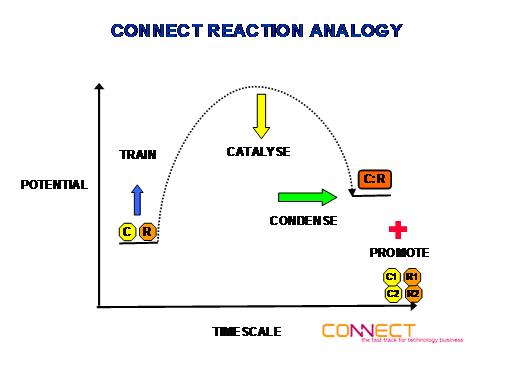
The activities of Connect Yorkshire can be catagorised into four areas and the chemists among you can think of us as being involved in a reaction. We train companies to help then make the most of what they have got and put their best foot forward, maximising their standalone potential. We help catalyse growth by lower the activation barrier to change and condense the journey, so they get to where they want to go faster. And we promote innovation, by bringing together more and more companies with the resources they need to succeed and raising the temperature and pressure to increase the chances of associations forming. This analogy to a chemical reaction is pertinent as we develop our activities.

Wednesday, July 12, 2006

Award nomination for Connect sponsor

We nominated one of our sponsors, Shaun Mullins of Horwath Clark Whitehill as IOD Yorkshire & Humber Business Advisor of the Year and its great that he has been shortlisted; the award will be at a Gala Dinner on 7 September

Friday, July 07, 2006

Lack of Proof of Concept Funding

We need more people starting up knowledge-based businesses. We have to acknowledge success if far from certain. There will be failures: unless there are we, as a region, are being too conservative in our thinking. However, with the help of organisations like Connect we can load the dices in favour of success and avoid the mistakes of the past. Enterprise and innovation is not a one way street. We need good technology that matches to a market need. All too often an idea misses the mark; aligning the technology with an addressable market need is what innovation is all about. Connecting entrepreneurs with the resources they need to nurture their initial seed of an idea until it reaches sustainability is a key part of the equation.

A key part of this that is lacking in the Yorkshire region is Proof of Concept funding. If we look to our neighbours, the North East has a £10M fund, set up to stimulate the growth of new technology companies. The North West similarly has access to the Rising Stars fund that backs early stage companies. These funds typically put £25-60K into a company at inception, with the option to invest further if the idea is shown to have legs. What access do would-be entrepreneurs have to funding at this level in the Yorkshire region? The reality is very little, but this is a key part of the innovation landscape.

Some pump priming is needed if we expect the region to generate sustainable technology businesses further down stream. The reality is that 3 out of 4 of these investments may not generate a return, but the ones that do will make up for the others - or that is how it should be if we are finding the correct balance between risk and reward.

Sunday, July 02, 2006

Promoting an Enterprise Culture

Creating a more enterprising culture is fundamental to the future of the regional economy. We need to applaud innovators and risk takers, celebrate their successes and help them avoid many of the potential pitfalls that stand in their way. That's where we come in: Connect Yorkshire helps young technology companies by linking them with the resources they need to succeed: investment, markets, management, partners, and support services. We are here to help businesses that need a boost to reach their 'escape velocity'.

Connect has been active in Yorkshire for nearly four years and has help over a hundred technology companies raise over £13M of investment. Every year numerous more technology companies attend Connect’s various programmes. The vast majority of these businesses are started by normal people who have seen a gap in the market or how to do something quicker, smarter or cheaper.

Starting a new technology business is not easy and its a long hard road, but the potential rewards are great - just ask James Dyson! Connect brings together like-minded people and together we all achieve more than we could ever alone. If you are thinking of starting a technology business or have a great idea but don't know how to progress it, come and talk to us. We are here to help.

Friday, June 30, 2006

Academic Involvement Benefits Everyone

While we have a lot of general business savvy people involved in our Company Assessment Groups (CAGs), but we are looking to involving more academics who might provide insights from a technical perspective. We also hope this will help promote a more enterprising culture by exposing participants to the commercialisation process. Maybe they will be inspired to start their own business or realise something they are working on in the lab has commercial legs. What's interesting is that the solution orientation of many fledgling companies coming from the private sector, contrasts the universities, where the technology comes first and the application second. Maybe we need to come at this issue from both ends to maximise our outputs.

Yorkshire has universities with world class research and teaching credentials. Almost 80 per cent of the departments at the University of York, for example, were given 5 or 5* ratings for research, meaning research was of international importance. Three of our universities are within the top 30 in the UK. Why then is the Yorkshire and Humber region languishing in 8th place for innovation in the UK? The way to ensure a better research to innovation ratio is to increase the amount of research inspired by commercial needs and bridge the gap between technology and commercial exploitation.

Any academics intrigued by all this, please contact Glen Hopkinson at Connect.

Monday, June 26, 2006

A Public-Private Partnership That Works

Connect is a perfect example of public-private partnership that works. As a not-for-profit company, Connect plays a pivotal role at the interface between technology, enterprise and business. We are part supported by a grant from Yorkshire Forward, but that’s only part of the story. Over thirty companies partner with Connect to deliver its programmes. The involvement of our sponsors is invaluable and contributes immensely to the quality and relevance of the product. In addition, Connect can tap into the skills of many of the region’s most successful technology entrepreneurs. This invaluable knowledge and experience is on offer to young technology companies across the region.

Friday, June 23, 2006

Yorkshire Forward Bioscience Awards

Prof. Heinz Woolf spoke after dinner and made a number of good points. According to Prof. Woolf, people who generate ideas may not be the best ones to sort the good from the bad (from a commercialisation perspective). What they need is input from a good 'editor' - someone who understands science and business, and has the scars to prove it! This involvement may be quite limited, but key to choosing the good ideas and driving them in a commercial direction. Once a proof of concept is achieved, someone then has to run with the idea and dot the i's and cross the t's. Again this may need someone else who is more operationally orientated: a details person. Rarely is one person good at doing all three (or interested in them). Indeed, it may be a mistake to try to make academics into entrepreneurs by asking them to cross over from being a generator of ideas to a running a business. Food for thought! The dinner was good also.