Tuesday, July 25, 2006

InvestorQuest £1M Challenge

Fancy getting your hands on your share of the £1M earmarked by our sponsors, VIKING, YFM, EV and WYPOCF, for investment in early-stage companies seeking funds? Then check out the InvestorQuest page of our web site for more information. The whole Connect team has been at Kirkstall Abbey shooting some promotional pictures dressed as knights seeking the holy grail -which turned up in a trophy shop in York! Looking the part, we got into the Yorkshire Post on Saturday! Join the quest for the 'holy grail' a share of £1m business ...

Monday, July 17, 2006

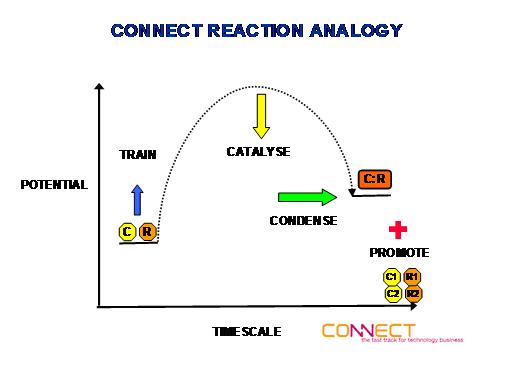
Getting A Reaction Going


The activities of Connect Yorkshire can be catagorised into four areas and the chemists among you can think of us as being involved in a reaction. We train companies to help then make the most of what they have got and put their best foot forward, maximising their standalone potential. We help catalyse growth by lower the activation barrier to change and condense the journey, so they get to where they want to go faster. And we promote innovation, by bringing together more and more companies with the resources they need to succeed and raising the temperature and pressure to increase the chances of associations forming. This analogy to a chemical reaction is pertinent as we develop our activities.

Wednesday, July 12, 2006

Award nomination for Connect sponsor

We nominated one of our sponsors, Shaun Mullins of Horwath Clark Whitehill as IOD Yorkshire & Humber Business Advisor of the Year and its great that he has been shortlisted; the award will be at a Gala Dinner on 7 September

Friday, July 07, 2006

Lack of Proof of Concept Funding

We need more people starting up knowledge-based businesses. We have to acknowledge success if far from certain. There will be failures: unless there are we, as a region, are being too conservative in our thinking. However, with the help of organisations like Connect we can load the dices in favour of success and avoid the mistakes of the past. Enterprise and innovation is not a one way street. We need good technology that matches to a market need. All too often an idea misses the mark; aligning the technology with an addressable market need is what innovation is all about. Connecting entrepreneurs with the resources they need to nurture their initial seed of an idea until it reaches sustainability is a key part of the equation.

A key part of this that is lacking in the Yorkshire region is Proof of Concept funding. If we look to our neighbours, the North East has a £10M fund, set up to stimulate the growth of new technology companies. The North West similarly has access to the Rising Stars fund that backs early stage companies. These funds typically put £25-60K into a company at inception, with the option to invest further if the idea is shown to have legs. What access do would-be entrepreneurs have to funding at this level in the Yorkshire region? The reality is very little, but this is a key part of the innovation landscape.

Some pump priming is needed if we expect the region to generate sustainable technology businesses further down stream. The reality is that 3 out of 4 of these investments may not generate a return, but the ones that do will make up for the others - or that is how it should be if we are finding the correct balance between risk and reward.

Sunday, July 02, 2006

Promoting an Enterprise Culture

Creating a more enterprising culture is fundamental to the future of the regional economy. We need to applaud innovators and risk takers, celebrate their successes and help them avoid many of the potential pitfalls that stand in their way. That's where we come in: Connect Yorkshire helps young technology companies by linking them with the resources they need to succeed: investment, markets, management, partners, and support services. We are here to help businesses that need a boost to reach their 'escape velocity'.

Connect has been active in Yorkshire for nearly four years and has help over a hundred technology companies raise over £13M of investment. Every year numerous more technology companies attend Connect’s various programmes. The vast majority of these businesses are started by normal people who have seen a gap in the market or how to do something quicker, smarter or cheaper.

Starting a new technology business is not easy and its a long hard road, but the potential rewards are great - just ask James Dyson! Connect brings together like-minded people and together we all achieve more than we could ever alone. If you are thinking of starting a technology business or have a great idea but don't know how to progress it, come and talk to us. We are here to help.

Friday, June 30, 2006

Academic Involvement Benefits Everyone

While we have a lot of general business savvy people involved in our Company Assessment Groups (CAGs), but we are looking to involving more academics who might provide insights from a technical perspective. We also hope this will help promote a more enterprising culture by exposing participants to the commercialisation process. Maybe they will be inspired to start their own business or realise something they are working on in the lab has commercial legs. What's interesting is that the solution orientation of many fledgling companies coming from the private sector, contrasts the universities, where the technology comes first and the application second. Maybe we need to come at this issue from both ends to maximise our outputs.

Yorkshire has universities with world class research and teaching credentials. Almost 80 per cent of the departments at the University of York, for example, were given 5 or 5* ratings for research, meaning research was of international importance. Three of our universities are within the top 30 in the UK. Why then is the Yorkshire and Humber region languishing in 8th place for innovation in the UK? The way to ensure a better research to innovation ratio is to increase the amount of research inspired by commercial needs and bridge the gap between technology and commercial exploitation.

Any academics intrigued by all this, please contact Glen Hopkinson at Connect.

Monday, June 26, 2006

A Public-Private Partnership That Works

Connect is a perfect example of public-private partnership that works. As a not-for-profit company, Connect plays a pivotal role at the interface between technology, enterprise and business. We are part supported by a grant from Yorkshire Forward, but that’s only part of the story. Over thirty companies partner with Connect to deliver its programmes. The involvement of our sponsors is invaluable and contributes immensely to the quality and relevance of the product. In addition, Connect can tap into the skills of many of the region’s most successful technology entrepreneurs. This invaluable knowledge and experience is on offer to young technology companies across the region.

Friday, June 23, 2006

Yorkshire Forward Bioscience Awards

Prof. Heinz Woolf spoke after dinner and made a number of good points. According to Prof. Woolf, people who generate ideas may not be the best ones to sort the good from the bad (from a commercialisation perspective). What they need is input from a good 'editor' - someone who understands science and business, and has the scars to prove it! This involvement may be quite limited, but key to choosing the good ideas and driving them in a commercial direction. Once a proof of concept is achieved, someone then has to run with the idea and dot the i's and cross the t's. Again this may need someone else who is more operationally orientated: a details person. Rarely is one person good at doing all three (or interested in them). Indeed, it may be a mistake to try to make academics into entrepreneurs by asking them to cross over from being a generator of ideas to a running a business. Food for thought! The dinner was good also.

Friday, June 16, 2006

Investment Forum On A High

Record numbers of companies presenting, investors with cheque books at the ready, and a champagne reception to finish. What more could you want? The event got great media coverage, with a number of the presenting companies raising their profile by being featured in the local press. All the presenters benefited from our mentoring process and this resulted in some well honed pitches that impressed the panel. The general concensus seemed to be that this was the best event we have ever held. Check out the Connect Yorkshire website for Podcasts of each of the presentations.

Tuesday, May 23, 2006

Company Assessment Group Meetings

In the run up to our June Investment Forum we are holding a number of 'CAGs' to help the presenting companys hone down and refine their investment pitches. This is an invaluable opportunity for presenter's to get feedback, share good practice and eliminate glitches. Often it is not until entrepreneurs have made their pitch to investors and been turned down that they appreciate what they could improve on - and then it's just too little, too late. The CAGs are made up of the mentors that are assigned to each company that are drawn from our sponsors. The companies get high-quality feedback from people in the know. So when they present at the Forum, they have the best possible chance of winning over investors and raising the finance they need to make their dreams a reality. This mentoring and support is a key part of the Connect model.

Tuesday, May 16, 2006

Bioscience YorkshireEnterprise Fellows

Academic research targeted explicitly at producing commercialisable technology is the focus of what is said to be the largest cluster of its type in Europe. And its happening here in Yorkshire!
The Bioscience Yorkshire Enterprise Fellowship is designed for post-docs, researchers and PhD students who have the skills and the desire to create a business based on their research. The programme provides participants with the support and mentoring to commercialise their ideas and research findings. The goal of the scheme is to increase entrepreneurial activity in Yorkshire universities' bioscience departments and to accelerate and support the formation of solid and sustainable start-up bioscience businesses.

Attending presentations from the fellows, you could see how fired up about their research they were - but also how producing a commercial outcome was also explicitly part of their mindset - something that might have been alien to them had not this scheme focused their deliverables towards an addressable market! In the end this is what differentiates technology development from enterprise. Nearly half of the fellows are thinking about starting a business based on their ideas. Great stuff!

Thursday, April 20, 2006

Focusing on Selling

Most technology companies spend there 'youth' developing some IP and sometimes that's all they ever do. Their novel idea results in something that can be licenced to other companies that focus on exploiting this in the market. However, for many technology companies it is up to them to go out and sell their product or service. This requires a whole new skill set and focus that may not come naturally to the founders of the business. How you get past this growth stage is critical. The ability to demonstrate repeatable sales, significantly increases the chances of raising finance to fund expansion. All too many of the investment propositions we see have left it too late to start selling!

Indeed, many such innovators may believe all they need to do is make it! The reality is that only innovators in your market will seek it out. To really make the numbers stack up someone has got to go out and sell the dam thing to people that really could go either way! So you don't just need a good product, you need a good sales and marketing strategy -- and the people to execute. Get selling as soon as you can! If the objection is that your product needs another bell or whistle don't accept this. Someone, somewhere has to buy into your vision. This validation is key to raising investment. Go and get some ASAP!

Friday, April 07, 2006

The Enterprising Enterprise Show

For anyone thinking of starting up a business The Enterprise Shows are well worth a visit! I attended the Leeds event last Saturday and was extremely impressed with the amount of information immediately accessible to budding entrepreneurs.

Talk about time saving, in one place you can get instant advice on your business plan, talk to banks about financial issues, listen to real life experiences of business success, learn about funding, finding investment, insurance, patents, trading standards…………………. the list goes on. It certainly helps cut through the mass of support now available to new businesses and you can soon work out what’s relevant to you.

The HM Revenue and Customs team had a queue of people waiting to speak to them most of the day, who would have thought VAT was so interesting!

Thursday, March 30, 2006

Mapping Start-ups

I was reading Electronics Weekly last week, as you do, and noticed their ‘start-up map’. Listing all the young electronic businesses across the UK, it was really interesting to look at their geographical spread.

I’m afraid the Yorkshire region doesn’t exactly look like a hot bed of emerging technology within this sub-sector of technology. In total 5 companies were based within the boundaries of Yorkshire. Although I didn’t find this particularly surprising what did astound me were the numbers of companies coming out of the South East. 24 businesses were listed under Cambridge alone. No wonder we have difficultly persuading VCs to travel ‘up north’ - they have exciting investment prospects on their doorstep, and plenty of them.

That said, I know that the majority of companies that access Connect Yorkshire’s services have an IT base. Yorkshire definitely has greater activity within other sub-sectors of the technology industry, particularly within the digital and creative areas. Looking at the number of start-ups in the electronics sector in isolation is therefore not a true reflection of Yorkshire’s high tech talent. Our last Investment Forum in November proved that high quality deals in a sizable number are there for the taking.

For me what the map highlights is the power of transcending traditional regional boundaries particularly when attracting big spenders from the south. The North East had 4 businesses listed whilst the Manchester area had 6. If this start-up activity were pooled with Yorkshire’s 5 businesses then the pulling power of the north would be greater. Perhaps then it would be easier to convince a VC the train journey was worth the time and expense!

Tuesday, March 07, 2006

YORKSHIRE’S TECHNOLOGY SECTOR 2020

Technology has been a buzz word in Yorkshire’s economic strategy for a number of years now. Technology is seen as an industry that has the potential to revitalise sub-regional economies, following the withdrawal of traditional industries. However despite all of this hype Yorkshire and Humber is still ranked eighth in a table of the most innovative regions in the UK.

So, how will the next 14 years shape up for the technology sector? I would argue that it depends largely on a change in culture among both our students at schools and universities and in business.

Creating the entrepreneurial attitude takes a lot of change. When you get right down to it, the attitudes of the young come from their role models, parents and teachers. We need to encourage our schools to celebrate British business success, and create a different attitude towards entrepreneurship.

A great example of a different attitude is America’s approach to business failure; I understand that in the US venture capitalists don’t like investing in you unless you’ve had at least one business failure. Here they turn up their nose at anyone whose company has gone onto insolvency. The Americans like those who have had the hard experience of trouble and the bottle to try again.

At Connect Yorkshire we prime technology companies for investment and growth. Every year about 40-50 technology companies attend our various programmes. The vast majority of these have been started by people who have been working in an industry for 10 or more years. They see a gap in the market, or a new development not being exploited by their employer, and try to build a technology business to fill that gap. Contrary to popular belief, the majority of new technology businesses do not come out of universities.

Universities by their very nature concentrate on academic research, and not on business creation. Research funding largely comes from the public sector, and is awarded purely on the quality of research – as judged by other academics, not on how much a university has contributed to the regional or national economy.

The way to ensure a better research to innovation ratio is to increase the amount of research inspired by commercial needs. This is where funding from research–led businesses is invaluable.
At the heart of the issue is that while research and innovation – defined as the commercial exploitation of ideas - maybe symbiotic, they are not synonymous; research does not necessarily yield innovation.

Over the last 20-30 years we have had three major technology businesses in Yorkshire, Systime in the 80’s, and Pace and Filtronic have continuing success from the 90’s to today. Systime employees have gone on to found numerous IT businesses in their own right. A few more success stories on this scale will give the technology sector in 2020 a significant boost.

Local medical device companies harbour a huge wealth of talented scientists; individuals experienced in product development, regulatory and advanced manufacturing. Johnson and Johnson Wound Management in Gargrave, Smith and Nephew in York and Hull and Depuy in Leeds are huge international companies with a strong footing in the region. Could it be by 2020, Yorkshire is considered the hub of Britain’s medical device industry?

It’s a strong possibility and emerging companies such as Cell Tran, Ullsys, and Avanticare prove with the correct support anything is possible. Success breeds success and if Yorkshire is perceived as a centre of medical device excellence the battle of attracting and then retaining key individuals to the region will be a lot easier. This will be helped by the activities of IP2IPO at Leeds and York Universities and Bio Fusion at Sheffield University.

These White Rose universities have the ability to support a flourishing medical device industry as we head towards 2020. In addition, I believe there will be many more technology businesses coming out of the students from Sheffield Hallam, Leeds Met, Hull, Bradford and the other non White Rose universities.

Brains must earn a crust too

We produce some of the best research academics in the world, yet their knowledge is locked away within the hallowed halls of academia.

The UK economy would benefit hugely from the innovation and technology which universities produce, but despite noises from central government about business and academia working together, the vast majority of academic revenue remains untapped.

Yorkshire has 12 higher education establishments - some with world class research and teaching credentials. Almost 80 per cent of the departments at the University of York, for example, were given 5 or 5* ratings fro research, meaning research was of international importance. Three of our universities are within the top 30 in the UK.

Why then is the Yorkshire and Humber region languishing in 8th place for innovation in the UK? Only the North East, Northern Ireland and Wales fare worse.

The answer is that the mindset behind attributing and recognising academic excellence is wrong. Currently the Research Assessment Review is carried out every four to five years. The process involves a panel of 685 people reviewing almost a quarter of a million pieces of research from 56,000 academics.

On the back of this huge bureaucratic exercise approximately £1 billion of research funding is allocated to UK universities. Incredibly nowhere is a university’s contribution to business or the economy mentioned.

In 2002 the government’s Investing in Innovation report stated that: “In an increasingly knowledge-driven global economy invention and innovation are critical to Britain’s long-term competitiveness. This requires a virtuous circle of innovation: from the very best research in science, engineering and technology in universities and science labs to the successful exploitation of new ideas, new science and new technologies by businesses.”

Currently the allocation of research grants appears to miss half of this “virtuous circle”. Yes, it assesses the quality of research, but it takes no account of “successful exploitation”.

In common with other sectors, higher education is subjected to league tables which institutions desperately try to climb. Research ratings play an important part along with other factors such as teaching quality assessment and entry standards.

However if we look at how university’s are ranked by employers the results are strikingly different from the usual research/teaching quality league tables published in five of the national broadsheets – the Daily Telegraph, Financial Times, The Times, and the Sunday Times.

For example the University of York is ranked from second (in the Daily Telegraph) to eighth (in the Financial Times). However when surveyed by 200 firms which regularly recruit graduates York’s ranking slips to twenty-ninth.By contrast, Leeds University is ranked between twenty–second (in the Telegraph) and thirty-fifth (in the Times); when it comes employers Leeds is ranked ninth in the UK.

Of course within Yorkshire there have been significant, if not fundamental, steps towards improving the situation. Three of our university’s have organisations which carry out a commercialisation function. Leeds University works with Techtran and IP2IPO. Sheffield University has two organisations - SUEL (Sheffield University Enterprises Ltd) and Bio Fusion, which is tasked with commercialising the IP output from the Biology and Chemistry departments. York, which is relatively new to the technology transfer game, has employed business development officers to help with its commercialisation activity.

SUEL has spun out 40 companies and created 60 external jobs. Techtran has also had its share of success with high profile spinouts including Syntopix and Potopharmacia under its belt. In York the Science City partnership between the university and the city council has created 60 companies and 2,600 jobs in the wider science and technology sector.

Other organisations such as Connect Yorkshire are also playing their part in helping young technology companies grow and become successful businesses contributing to the regional and national economies.

There have been some spectacular successes. BioFusion, spun out of Sheffield University, floated on AIM and raised £8.2 million. Bradford Particle Design, started by Dr Gwyn Humphreys of Bradford University in 1995 was acquired by Inhale Therapeutic Systems for £137m. Molecular Skincare, founded by Dr Simon Ward of Sheffield University, was brought by York Pharma for around £5.5 million.

These are fantastic achievements, but they are achieved despite the pervading culture of academic institutions and not because of it. To fulfil our national and regional potential we need fundamental changes in how we evaluate our universities. We must not be squeamish - the rest of the UK runs on capitalist money making principals and we cannot afford for our top brains not to.

Wednesday, February 22, 2006

Connecting with the Northern Way

The Norther Way Summit, held in York, brought together all three development agencies to discuss how we can all work together as a cohesive whole. Developing synergies, achieving more together than we can alone. Collaborate, compement and add-value. 1+1+1 = 5! All good stuff and exactly what Connect is all about!

From a management theory perspective, to promote teamwork across the three regions requires functional consistency and some 'subject/problem (solution?)' orientation that spans the geographic regions - see matrix versus functional in any book on organisational development. Connect, being focused on promoting and nuturing knowledge-based companies ideally fits, the bill. We are working closely with other regional Connects to develop our business model, to work collaboratively, yes, to achieve more together than we could alone.

Monday, February 20, 2006

What do Technology Companies Need To Succeed?

From the Sunday Times 19/2/2005 that caught our eye:

"It is vital that technology companies have the people who can turn their products into sales & profits. This means having the confidence, knowhow and balls to knock down doors."

This is exactly what our Fast Invest initiative is all about. Its easy to think your product is worldbeating and people will beat a path to your door. The reality is that for most businesses, you have to get out there and lead them to it!

"Just as important are control skills because fast-growing businesses change out of all recognition and the management have to handle the transistion from one office and ten employees to maybe 3,000 employees in a dozen offices around the country or abroad."

Nice problem to have, but seriously at each stage in a companies develop there are step changes that need to be navigated. Probably the hardest is going from an owner-managed situation, where the innovator has a finger in every pie, to building the cornerstones of a management team on which the rest of the organisation can be established. At some point the entrpreneur becomes the obstical to, rather than the reason for continued development.

"The difference between a good idea and a successful business is going out there and doing it."

How many ideas have you had, that a few years later someone else is doing. We've had a few in our time!

Tuesday, February 14, 2006

Welcome!

Connect Yorkshire is the fast track to growth for Yorkshire's technology companies. We nurture new enterprises in the region and help fast-track their development. We do this through a range of innovative products and services:

Fast Invest - loans of £10-50K to help kickstart fledgling technology businesses or help later-stage companies achieve sales life-off.

Fast Forward - help (read grilling) by a panel of experts on your business idea and direction to get a 360 degree perspective. Great for validating your USP's and looking at your approach from every angle.

Investor Readiness Programme - hone your Business Plan and pitch to sell you idea to investors or, indeed, customers.

Investment Forum - matching innovative young companies with investors looking for growth.

What else should we be doing to support technology companies? Let us know by posing your comments!